

·📅 4 Feb 2022·🔄 Updated: 15 Jun 2026
Go directly to
Crypto adoption looks very different in 2026 than it did during the 2021 bull market. Back then, many rankings focused on how many people said they owned Bitcoin, Ethereum or another coin. Today, the more interesting question is where crypto is actually being used — for trading, saving, remittances, stablecoins, DeFi, payments and access to global markets.
That distinction matters. A rich country can have huge institutional crypto volume, while a developing country may have smaller transactions but much deeper everyday usage. Someone in the United States may buy Bitcoin through an ETF or exchange account. Someone in Nigeria, Vietnam or Argentina may use stablecoins because local currency weakness, inflation or cross-border payment friction is a daily problem.
This is why old “crypto ownership by country” lists can now be misleading. They are still useful, but they only show one part of the picture. For a better 2026 view, we need to look at adoption through several lenses: retail usage, exchange activity, DeFi, institutional flows, stablecoin use and local economic incentives.
Top Countries for Crypto Adoption in 2026
The best-known global benchmark is the Chainalysis Global Crypto Adoption Index. Its 2025 index ranked countries by several forms of on-chain and exchange activity, rather than simply asking people whether they own crypto. In that index, India ranked first, followed by the United States, Pakistan, Vietnam and Brazil.
| Rank | Country | Why it matters |
| 1 | India | Huge retail base, strong exchange usage and broad grassroots crypto activity. |
| 2 | United States | Major institutional flows, ETF-driven legitimacy and deep exchange liquidity. |
| 3 | Pakistan | Strong retail adoption and growing use of crypto rails despite regulatory uncertainty. |
| 4 | Vietnam | Long-running retail crypto interest, active Web3 communities and high grassroots usage. |
| 5 | Brazil | Large Latin American market with strong exchange activity and stablecoin demand. |
| 6 | Nigeria | Heavy peer-to-peer and stablecoin usage, partly driven by currency pressure. |
| 7 | Indonesia | Large young population, strong trading activity and growing regulated crypto market. |
| 8 | Ukraine | High crypto usage relative to population and strong digital finance adoption. |
| 9 | Philippines | Remittances, mobile-first finance and gaming/Web3 history support adoption. |
| 10 | Russia | High crypto activity, partly shaped by sanctions, capital controls and cross-border needs. |
Crypto Lists view: this ranking is more useful than the older “percentage of people owning crypto” approach because it captures how money actually moves. Chainalysis explains that its adoption index looks at several types of crypto activity, including retail and institutional service usage, which makes it a better starting point for understanding real-world adoption than a simple survey of ownership.
India
India is the clearest crypto adoption leader in recent global rankings. That may surprise people who only look at regulation, because India has not always been an easy market for crypto companies. But user demand is enormous.
The country has a huge young population, strong mobile internet usage, active developer communities and a long-running appetite for digital finance. Crypto in India is not only about speculation. It also overlaps with Web3 development, global freelancing, remittances, stablecoins and access to digital assets outside the traditional banking system.
Unlike the European Union, which introduced the MiCA framework for crypto-asset service providers, India still relies on a mix of taxation, financial supervision and policy guidance. The Reserve Bank of India has repeatedly highlighted both the opportunities and risks associated with digital assets while the government continues to evaluate a broader regulatory framework.
United States
The United States is different from most countries on this list. Crypto adoption there is less about escaping a weak local currency and more about institutional access, investment products, venture capital, exchanges and financial infrastructure.
The approval and growth of spot Bitcoin ETFs helped make crypto more acceptable to traditional investors. The US also has deep liquidity, large exchanges, sophisticated custody providers and a very active developer ecosystem. It is not always the country with the highest percentage of people using crypto daily, but it remains one of the most important markets by value and infrastructure.
Pakistan
Pakistan has become one of the most important emerging crypto markets. The drivers are familiar: a young population, remittance needs, currency pressure, smartphone adoption and interest in global digital income.
For many users in markets like Pakistan, crypto is not just a high-risk investment. It can also be a tool for receiving money, storing value in dollar-linked assets, or accessing platforms that are difficult to reach through the local financial system.
Vietnam
Vietnam has appeared near the top of crypto adoption rankings for several years. The country has strong retail participation, a digitally active population and a history of interest in gaming, Web3 and blockchain applications.
Vietnam is also a good example of why adoption cannot be measured only by GDP. A country does not need to be one of the world’s richest economies to become highly active in crypto. In many cases, younger users and mobile-first behaviour matter more.
Brazil
Brazil is one of Latin America’s most important crypto markets. It has a large population, a sophisticated fintech sector and real demand for digital assets, especially when people want alternatives to local currency weakness or easier access to international markets.
Stablecoins have become particularly important across Latin America, and Brazil is a natural hub because of its size and financial infrastructure. It is also one of the countries where regulation is becoming more serious, which may help larger companies and institutions participate more confidently.
Nigeria
Nigeria remains one of the most interesting crypto markets in the world. Older rankings often placed it near the top for ownership, and newer adoption studies continue to show heavy activity.
The reasons are practical. The naira has faced major pressure, many people receive money from abroad, and traditional banking rails can be slow or restrictive. For some Nigerians, Bitcoin, USDT and other crypto assets are not mainly about getting rich. They are tools for savings, payments, freelancing and access to global markets.
That does not make crypto risk-free. It also explains why regulators pay close attention to the sector. The Financial Action Task Force has warned that virtual assets can make payments faster and cheaper, but also create money-laundering and terrorist-financing risks without proper regulation. In its guidance on virtual assets and crypto-related financial crime risks, FATF makes clear that adoption and compliance now have to move together.
Indonesia
Indonesia combines several crypto-friendly ingredients: a large population, young demographics, fast digital adoption and strong retail trading interest.
Crypto is not legal tender in Indonesia, but it has been allowed as a tradable asset under regulatory supervision. That creates a split that many countries now face: governments may not want crypto to replace national currency, but they still recognize that people want to trade, hold and use digital assets.
Ukraine
Ukraine has consistently shown high crypto usage relative to population. War, displacement, international donations and digital finance adoption have all played a role.
Crypto in Ukraine is not only a speculative story. It has been used for fundraising, cross-border transfers and emergency financial access. That gives Ukraine a different adoption profile from countries where crypto is mostly an investment product.
Philippines
The Philippines has several strong adoption drivers: remittances, mobile-first banking, overseas workers, gaming culture and a history of early Web3 experimentation.
During the last cycle, play-to-earn gaming helped put the Philippines on the crypto map. Some of that hype faded, but the deeper conditions remain. A large mobile population and heavy remittance flows make the country a natural fit for digital wallets, stablecoins and cheaper cross-border transfers.
Russia
Russia’s crypto activity is shaped by a very different set of factors. Sanctions, capital controls, cross-border payments and distrust of traditional channels have all influenced demand.
This is also why crypto adoption rankings need careful interpretation. High activity does not always mean a healthy or open consumer market. Sometimes it reflects financial restrictions, geopolitical pressure or people looking for ways around the normal banking system.
Countries That Used to Rank Higher
Several countries that appeared in older 2021 and 2022 ownership lists still matter, but their position looks different when newer data and real usage are considered.
Thailand
Thailand was often ranked very high in older crypto ownership surveys. It still has an active crypto community, but it is no longer the obvious global leader when measured by wider activity. Regulation, market cycles and the decline of speculative hype have all changed the picture.
Turkey
Turkey remains one of the most important crypto markets because of inflation, currency pressure and high public awareness of digital assets. Even if it does not always sit in the top five of newer adoption rankings, it is still one of the countries where crypto has a clear real-world reason to exist.
Argentina
Argentina is similar to Turkey in one important way: people understand currency risk because they live with it. Crypto and stablecoins are attractive because many Argentinians want exposure to dollars or dollar-linked assets.
For Crypto Lists, Argentina is one of the countries where raw ownership percentages may understate the practical importance of crypto. A smaller number of serious users in a high-inflation economy can matter more than a larger number of casual holders elsewhere.
South Africa
South Africa has one of Africa’s more developed financial markets and remains an important crypto country. It has stronger financial infrastructure than many neighbouring markets, which helps exchanges, fintech companies and investors operate more professionally.
The country may not always get the same attention as Nigeria, but it is still a serious crypto market, especially when looking at regulation, taxation and financial-sector maturity.
Singapore
Singapore is not always a mass-adoption leader, but it remains one of the world’s most important crypto hubs. The difference is that Singapore’s role is more institutional and regulatory than grassroots.
Many crypto companies, funds and infrastructure providers have used Singapore as a base, but that does not mean everyday ownership is higher than in emerging markets. This is a good reminder that “crypto hub” and “crypto adoption” are not always the same thing.
South Korea
South Korea has a very active trading culture and strong interest in digital assets. Local exchanges, retail traders and tech-savvy users have made it one of Asia’s most important crypto markets.
However, South Korea is also a heavily regulated and highly developed economy. Its crypto activity is more investment-led than survival-led, which makes it different from countries where stablecoins are used to escape inflation or weak banking access.
Why Emerging Markets Often Lead Crypto Adoption
The pattern is clear: many of the strongest crypto adoption countries are not the richest countries. They are countries where people have a practical reason to look for alternatives.
Currency pressure: If the local currency loses value quickly, Bitcoin or stablecoins can become more attractive.
Remittances: Countries with large overseas worker populations often have strong demand for cheaper cross-border transfers.
Banking gaps: Crypto wallets can sometimes reach people who are underserved by traditional banks.
Younger populations: Younger, mobile-first users are often more willing to experiment with digital assets.
Capital controls: In countries where moving money internationally is difficult, crypto demand often rises.
Why Rich Countries Still Matter
It would be wrong to say crypto adoption is only an emerging-market story. The United States, United Kingdom, South Korea, Japan and parts of Europe are crucial because they bring institutional money, regulation, custody, ETFs, exchanges, developers and venture capital.
In simple terms, emerging markets often drive everyday crypto usage, while richer markets often drive infrastructure and institutional legitimacy.
This is also why the United States ranking so highly in newer adoption data matters. It suggests crypto is no longer only a retail speculation tool. It is increasingly connected to mainstream finance through ETFs, custody services, public companies, payment providers and regulated investment products.
What About Europe?
Europe has strong crypto activity, but it is more fragmented. Germany, France, the Netherlands, Spain, Sweden and the UK all have users, companies and investors, but they rarely dominate global adoption rankings in the same way as India, Nigeria, Brazil or Vietnam.
Part of the reason is simple: many Europeans already have stable currencies, bank access and developed payment systems. The urgency is lower. Crypto is often treated as an investment, not a daily financial necessity.
Regulation is also becoming more formal. The EU’s MiCA framework created a common rulebook for many crypto-asset service providers, and the European Securities and Markets Authority describes MiCA as part of the EU’s framework for crypto-asset markets, with a focus on transparency, supervision and investor protection.
So, Where Do Most People Use Crypto?
If we are talking about broad, real-world adoption, the leading countries are now India, the United States, Pakistan, Vietnam, Brazil, Nigeria, Indonesia, Ukraine, the Philippines and Russia, based on the latest Chainalysis global adoption ranking.
If we are talking about percentage of people who say they own or use crypto, some survey-based lists may still show countries such as Nigeria, Thailand, Turkey, Argentina or the Philippines near the top.
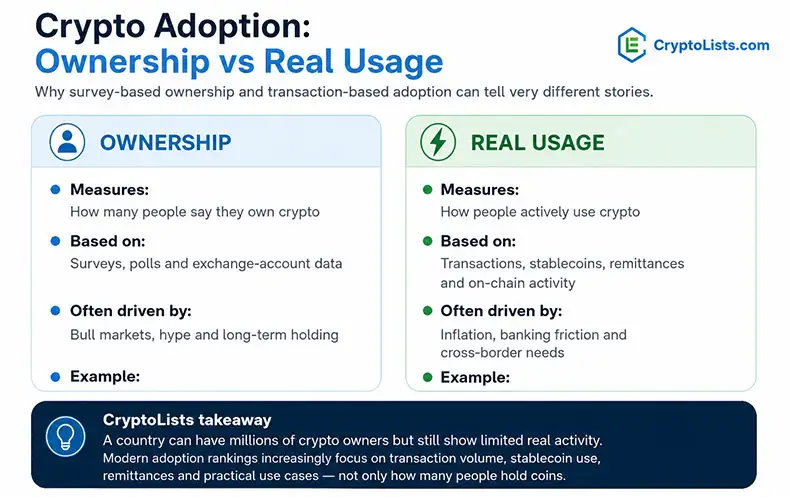
The honest answer is that there is no single perfect ranking. Ownership surveys measure one thing. Exchange flows measure another. DeFi activity, stablecoin usage, remittances and institutional investment all tell different parts of the story.
Final View from Crypto Lists
The most important change since 2021 is that crypto adoption is no longer only about who bought Bitcoin during a bull market. In 2026, adoption is more practical and more divided by use case.
In the United States, crypto adoption is increasingly institutional. In India, it is massive and retail-driven. In Nigeria and Argentina, it is closely linked to currency pressure and stablecoin demand. In the Philippines, remittances and mobile-first finance matter. In Brazil, fintech growth and regulation are pushing the market forward.
That is why the old question “which country owns the most crypto?” is too narrow. The better question is: where does crypto solve a real problem?
When viewed that way, the strongest adoption markets are not always the ones with the loudest crypto marketing. They are often the places where people need faster payments, better savings tools, access to dollars, cheaper transfers or a way into global digital finance.
Crypto Adoption: Ownership vs Real Usage
FAQ
Which country has the highest crypto adoption in 2026?
India is the leading country in the latest Chainalysis Global Crypto Adoption Index, followed by the United States, Pakistan, Vietnam and Brazil.
Why do developing countries often rank high for crypto adoption?
Developing countries often rank high because crypto can help with remittances, currency weakness, inflation, banking access and cross-border payments. In these markets, crypto may solve practical financial problems rather than only serving as an investment.
Is crypto adoption the same as crypto ownership?
No. Crypto ownership usually means people say they hold or use crypto. Crypto adoption can include exchange activity, stablecoin transfers, DeFi usage, institutional flows, remittances and other real-world activity.
Why is the United States ranked so highly?
The United States ranks highly because of deep exchange liquidity, institutional investment, ETF activity, venture capital, custody infrastructure and a large retail market.
Which regions are strongest for crypto adoption?
Asia-Pacific, Latin America and parts of Africa are especially important for grassroots crypto adoption. North America remains highly important for institutional crypto activity and financial infrastructure.