
·📅 24 Apr 2022·🔄 Updated: 12 Jun 2026
Fidelity’s crypto and metaverse ETF launch looked exciting in 2022, but the most important detail was easy to miss: these funds did not buy Bitcoin, Ethereum, Apecoin, Decentraland, Sandbox or other crypto tokens directly. They were equity ETFs built around companies connected to crypto, digital payments and the broader metaverse theme.
That difference matters even more in 2026. Since the original launch, the crypto ETF market has changed dramatically. Spot Bitcoin and Ethereum products now exist in the United States, institutional interest in digital assets has grown, and the metaverse hype cycle has cooled. Fidelity’s Crypto Industry and Digital Payments ETF (FDIG) and Metaverse ETF (FMET) still deserve attention, but they should be understood as thematic stock funds, not as direct crypto exposure.
This updated Crypto Lists guide explains what Fidelity launched, what FDIG and FMET actually hold, how they differ from spot crypto ETFs, and why investors should look beyond the word “crypto” in a fund name before buying.
Introduction
Fidelity announced the launch of several new ETFs in April 2022, including two thematic funds linked to fast-growing areas of the digital economy: the Fidelity Crypto Industry and Digital Payments ETF (FDIG) and the Fidelity Metaverse ETF (FMET). The launch also included sustainable fixed income funds, such as the Fidelity Sustainable Low Duration Bond ETF and Fidelity Sustainable Core Plus Bond ETF.
The launch made sense at the time. Crypto was still a major retail and institutional story, payment companies were expanding into digital assets, and the metaverse was being promoted as the next version of the internet. Fidelity also already had a strong digital asset reputation compared with many traditional asset managers.
However, the original article needed one major correction: FDIG was never a fund for holding cryptocurrencies directly. Fidelity’s own launch announcement described FDIG and FMET as equity products that track Fidelity indices and offer exposure to companies connected with these sectors. You can see Fidelity’s original announcement here: Fidelity’s ETF launch release.
Crypto Lists view: For readers looking at this today, the headline question is not “is Fidelity launching crypto ETFs?” It is “what type of crypto exposure am I actually getting?” That is where many investors make mistakes with thematic funds.
Objective
FDIG seeks investment results that generally correspond to the Fidelity Crypto Industry and Digital Payments Index before fees and expenses. The fund normally invests at least 80% of its assets in companies included in that index, which are connected to cryptocurrency, blockchain technology and digital payment processing.
FMET follows a similar idea for the metaverse theme. Instead of buying virtual land tokens or metaverse cryptocurrencies, it tracks companies connected to the future internet, augmented reality, virtual worlds, gaming infrastructure, semiconductors, platforms and related services.
This is a key distinction. A crypto-sector equity ETF can move with crypto sentiment, but it is still a stock fund. Its holdings may include miners, exchanges, payment companies, technology firms and infrastructure companies. That means stock-market risk, business risk, valuation risk and sector concentration all still apply.
| Fund | Main exposure | What it does not do |
| FDIG | Crypto industry, blockchain and digital payments companies | Does not hold Bitcoin, Ethereum or altcoins directly |
| FMET | Metaverse-related equities and technology companies | Does not hold metaverse tokens such as MANA, SAND or APE directly |
| Spot crypto ETF | Direct exposure to the underlying crypto asset through a regulated product | Usually does not give exposure to miners, exchanges or payment stocks |
The U.S. SEC’s investor education material is useful here because ETF shares trade on exchanges at market prices and can differ from net asset value during the trading day. For a general investor-friendly explanation, see the SEC’s ETF bulletin: Investor.gov guide to exchange-traded funds.
Similar Ideas by Fidelity
Fidelity’s move into crypto-linked ETFs was not isolated. The firm had already been one of the more active traditional financial companies in digital assets. It later became known for regulated crypto exposure products, including spot Bitcoin and Ethereum fund offerings, while also continuing to explore tokenization and stablecoin-related infrastructure.
That is why FDIG is interesting historically. It came before the U.S. spot Bitcoin ETF wave and offered a way for investors to express a crypto-related view through listed companies rather than through coins. In 2022, that mattered because U.S. investors had fewer simple regulated options for direct crypto exposure.
By 2026, the comparison is different. Investors can now separate three ideas more clearly: owning crypto directly, buying a spot crypto ETF, or buying a crypto-sector equity ETF. Those are not the same trade.
Direct crypto: You own the asset or hold it through an exchange or wallet, with custody and security considerations.
Spot crypto ETF: You get price exposure to the asset through a regulated market product, but without self-custody.
Crypto equity ETF: You own companies whose businesses may benefit from crypto adoption, but stock-specific factors can dominate performance.
What about the spread on FMET?
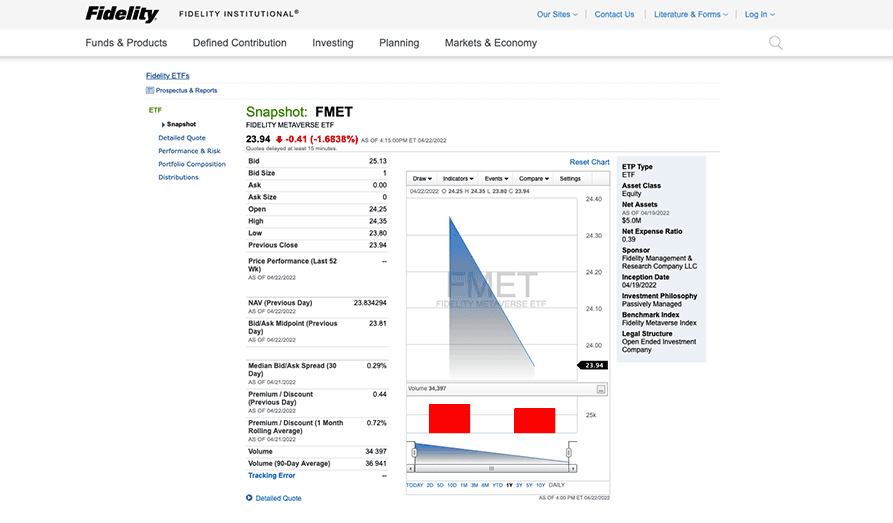
When FMET launched, trading costs and spreads were worth watching because new thematic ETFs can be thinly traded in their early days. A quoted spread of around 0.29% may not sound huge, but it matters for investors who buy and sell frequently or place market orders during volatile periods.
For any ETF, the visible expense ratio is only one part of the cost. Investors should also check the bid-ask spread, trading volume, premium or discount to net asset value, and whether the ETF is liquid enough for their order size.
FMET’s expense ratio was launched at 0.39%, which was competitive for a niche thematic ETF at the time. That does not automatically make it a good investment. It simply means the fee was not the biggest problem. The bigger question is whether the metaverse theme delivers enough real earnings growth to justify buying a concentrated basket of related stocks.
Crypto Lists note: If a theme is fashionable, the ETF may launch near peak enthusiasm. That does not mean the fund provider is wrong, but it does mean investors should ask whether they are buying long-term infrastructure or yesterday’s marketing buzzword.
What is in Fidelity’s Metaverse portfolio?
The original article guessed that FMET might include metaverse cryptocurrencies such as Apecoin (APE), Decentraland (MANA), The Sandbox (SAND) and Axie Infinity (AXS). That was not the right way to frame the fund.
FMET is an equity ETF. Its portfolio is built around listed companies, not metaverse tokens. In 2026, public ETF data providers show FMET holding technology and communication-related names such as semiconductor companies, platform companies and major technology businesses. That makes the fund closer to a future-internet technology basket than a direct play on crypto gaming tokens.
This matters because token performance and stock performance can diverge sharply. A metaverse token can lose traction while a chipmaker or platform company still performs well because it has exposure to AI, gaming, cloud infrastructure or devices. The reverse can also happen.
Entering a world of competition
Fidelity entered a crowded thematic ETF market. By the time FDIG and FMET launched, investors already had access to many funds built around blockchain, crypto miners, fintech, digital payments, gaming and metaverse themes. Fidelity’s advantage was not being first. Its advantage was brand trust, distribution and competitive pricing.
That said, thematic ETFs can be dangerous when investors focus only on the story. A fund name can sound exciting, but the actual holdings may be much more ordinary. FDIG, for example, may contain miners, exchanges, payment processors and infrastructure stocks. FMET may contain large technology companies that only partly depend on the metaverse.
Reuters reported at the time that Fidelity also entered Decentraland with an educational experience called Fidelity Stack, partly to reach younger investors. That was a useful marketing experiment, but it also showed how quickly the metaverse theme became mixed with brand-building rather than pure investment fundamentals. You can read the Reuters background here: Fidelity enters the metaverse in search of young investors.
For Crypto Lists readers, the practical takeaway is simple: do not buy FDIG because you want to own Bitcoin, and do not buy FMET because you want to own metaverse coins. These are stock ETFs. They may still be useful, but only if you want exposure to companies operating around those themes.
Crypto Lists verdict
Fidelity’s 2022 ETF launch was important because it showed that large traditional asset managers were taking crypto, blockchain, digital payments and virtual-world infrastructure seriously. But the original excitement around “crypto ETFs” needs a 2026 reality check.
FDIG is not a Bitcoin ETF. FMET is not a basket of metaverse tokens. Both are thematic equity ETFs with company-level risk, market risk and sector concentration. They may benefit when digital assets, blockchain infrastructure or future-internet themes perform well, but they can also underperform even when crypto prices rise.
Our view is that FDIG is the more relevant fund for Crypto Lists readers because it connects more directly to crypto infrastructure, miners, exchanges and payments. FMET is more of a broad technology theme, and the metaverse label has lost some of the excitement it had in 2021 and 2022.
Before buying either fund, check the latest holdings, expense ratio, bid-ask spread, assets under management and whether the fund gives the exposure you actually want. In thematic investing, the label is only the starting point. The holdings are the truth.
FAQ
Does Fidelity FDIG hold Bitcoin directly?
No. FDIG is a crypto industry and digital payments equity ETF. It invests in companies connected to crypto, blockchain and payments, not directly in Bitcoin or other cryptocurrencies.
Does Fidelity FMET hold metaverse coins?
No. FMET is an equity ETF. It holds listed companies connected to the metaverse theme, not tokens such as MANA, SAND, APE or AXS.
What is the expense ratio for FDIG and FMET?
Both funds launched with an expense ratio of 0.39%. Investors should still check Fidelity’s latest fund pages before buying, as fees and fund details can change.
Is FDIG the same as a spot Bitcoin ETF?
No. A spot Bitcoin ETF seeks direct exposure to Bitcoin’s price. FDIG gives exposure to companies that operate in or around the crypto and digital payments industry.
Are thematic ETFs risky?
Yes. Thematic ETFs can be concentrated in volatile sectors and may perform poorly if the theme loses investor interest or if the underlying companies disappoint.