
·📅 14 May 2022·🔄 Updated: 12 Jun 2026
Terra Luna and TerraUSD were not just another crypto crash. They became one of the clearest warnings in crypto history: a stablecoin can look safe, grow fast, attract billions, and still fail within days if the design depends on confidence more than real backing.
When this article was first published in May 2022, LUNA, the native token of the Terra network, had collapsed to almost zero and UST had fallen far below its intended $1 peg. At the time, the market was still trying to understand whether this was a temporary panic, a coordinated attack, a design failure, or all of the above.
Looking back from 2026, the story is much clearer. Terra’s collapse was not just about one bad week in crypto. It exposed the weakness of algorithmic stablecoins, triggered regulatory scrutiny, damaged trust in high-yield crypto products and wiped out tens of billions in market value. The U.S. Securities and Exchange Commission later said the collapse erased around $40 billion in market value almost overnight, and Terraform Labs and Do Kwon agreed to pay more than $4.5 billion after a fraud verdict.
This updated Crypto Lists review explains what happened, why UST failed, how LUNA entered a death spiral, what role the Bitcoin reserve played, and what crypto users should still learn from Terra today.
What happened to Terra Luna and UST?
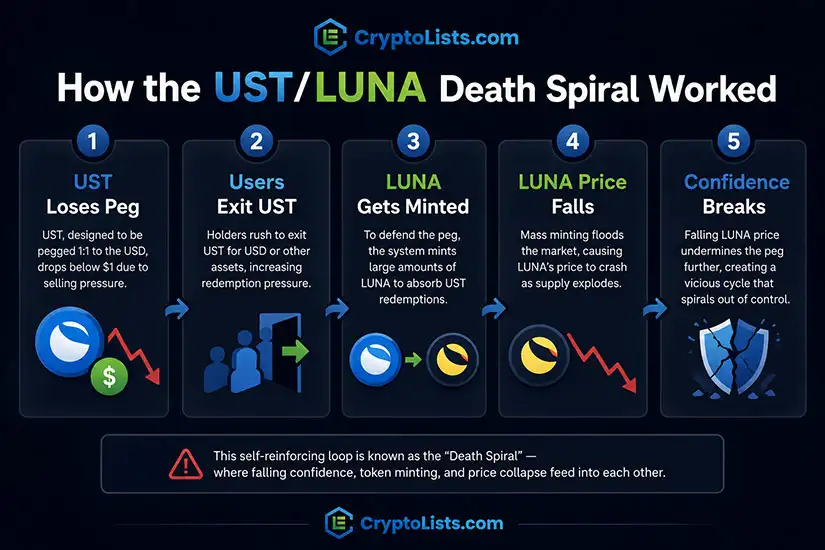
TerraUSD, usually called UST, was designed to trade at $1. Unlike fiat-backed stablecoins such as USDT or USDC, UST was an algorithmic stablecoin. It did not rely mainly on cash, Treasury bills or traditional assets sitting in reserve. Instead, the system used a mint-and-burn mechanism with LUNA to try to keep UST close to $1.
In simple terms, the idea was that users could swap 1 UST for $1 worth of LUNA. If UST traded below $1, arbitrage traders were expected to buy cheap UST, redeem it for LUNA and help push UST back toward the peg. On paper, it looked clever. In a panic, it created a vicious loop.
As confidence in UST weakened, more holders tried to exit. The system had to mint more LUNA to absorb redemptions. That new LUNA supply pushed the LUNA price lower. A lower LUNA price meant even more LUNA had to be created to support UST exits. This is the classic Terra death spiral.
Crypto Lists observation: The most important lesson is not that “stablecoins are unsafe.” It is that stablecoins are not all the same. A fiat-backed stablecoin, an over-collateralised crypto stablecoin and an algorithmic stablecoin can carry completely different risks, even if all three appear to trade at $1 during calm markets.
Terra’s Bitcoin Reserve
Before the collapse, the Luna Foundation Guard built a large Bitcoin reserve to help defend the UST peg. Do Kwon had publicly discussed plans to accumulate as much as $10 billion in Bitcoin reserves, while the reserve already held billions in crypto assets before the crisis.
The logic was easy to understand: if UST came under pressure, Bitcoin reserves could be deployed to buy UST and restore confidence. The problem was timing. When the peg broke, the entire crypto market was already fragile. Selling or deploying large amounts of Bitcoin in a stressed market did not restore trust quickly enough.
The Bitcoin reserve became part of the wider panic. Instead of calming the market, it raised more questions. How much Bitcoin was left? Where had it gone? Was it used effectively? Could a volatile asset like Bitcoin really support a stablecoin during a market crash?
That final question matters. Bitcoin can be a strong long-term asset, but it is not the same as a cash reserve. If a stablecoin needs emergency liquidity during a panic, highly volatile collateral can fall at exactly the wrong moment.
Effect on Tether
UST was one of the largest stablecoins in the world before the collapse, so the damage quickly spread beyond Terra. Traders began asking a much bigger question: if one major stablecoin could fail so violently, could others be next?
That fear briefly affected Tether. USDT traded below $1 for a short period during the market stress, but it regained its peg. The difference was important. UST relied on an algorithmic relationship with LUNA. Tether says USDT is backed by reserves, although Tether has also faced long-running questions about transparency, reserve quality and regulatory oversight.
For users, the key point is that “stablecoin” is a category, not a guarantee. The backing model, redemption process, issuer, jurisdiction, audits, liquidity and exchange support all matter.
| Stablecoin type | How it tries to stay stable | Main risk |
| Algorithmic stablecoin | Uses token incentives, minting and burning | Can enter a death spiral if confidence breaks |
| Fiat-backed stablecoin | Issuer claims reserves support redemptions | Reserve quality, regulation and redemption access |
| Crypto-collateralised stablecoin | Backed by crypto collateral, often over-collateralised | Collateral volatility and liquidation pressure |
The Terra collapse did not destroy Tether, USDC or the stablecoin sector. It did, however, make users more aware of the differences between stablecoin designs. That was long overdue.
Why Does the Collapse of LUNA and UST Matter?
The Terra collapse matters because it was not a small experimental token failing quietly in the corner of DeFi. UST and LUNA had reached huge scale. The ecosystem included retail investors, funds, exchanges, DeFi protocols and yield products that many users treated as safer than they really were.
One of the most painful parts of the story was Anchor Protocol, where users were attracted by very high yields on UST deposits. In hindsight, the yield helped create confidence and growth, but it also encouraged users to treat UST like a savings product. That made the collapse even more damaging for people who did not fully understand the risk.
The aftermath also became legal and political. In June 2024, the SEC announced that Terraform Labs and Do Kwon agreed to pay more than $4.5 billion after a jury verdict connected to fraud and investor losses. The SEC said the collapse wiped out around $40 billion in market value and caused devastating losses for many investors. You can read the SEC’s official release here: Terraform and Kwon to Pay $4.5 Billion Following Fraud Verdict.
Stablecoin regulation also moved higher on the agenda. During the crisis, U.S. Treasury Secretary Janet Yellen pointed to TerraUSD as an example of why stablecoin rules were needed. For official policy context, the U.S. Treasury’s stablecoin work remains a useful reference point: U.S. Treasury stablecoins resources.
Crypto Lists view: Terra was a turning point because it showed that impressive branding, rapid growth, large market cap and charismatic founders are not substitutes for a resilient design. If the product only works while everyone believes it works, the real risk is hidden until the exit door gets crowded.
What investors can learn from Terra Luna
1. A stable price is not the same as low risk. UST looked stable for a long time because it traded close to $1. That did not mean the mechanism was safe under stress.
2. High yield usually means hidden risk. If a stablecoin deposit pays far more than normal cash or bond yields, the extra return has to come from somewhere. It may be subsidised, temporary or dependent on constant growth.
3. Market cap can be misleading. A token can be worth billions on paper but still collapse if liquidity disappears and confidence breaks.
4. Reserves need to match the promise. If users expect a stablecoin to behave like dollars, euros or pounds, they should understand what assets actually support redemptions and how quickly those assets can be used.
5. “Decentralised” does not automatically mean safer. Governance, validators, bridges, exchanges, founders and large holders can all affect outcomes in a crisis.
Conclusion
The Terra Luna collapse remains one of the most important events in crypto history. In May 2022, UST broke its peg and LUNA entered a supply-driven death spiral that destroyed confidence in the Terra ecosystem. The blockchain was halted, the token economics failed under pressure, and billions in market value disappeared within days.
From a 2026 perspective, the biggest lesson is simple: stablecoins need more than a good story. They need transparent backing, realistic yield, deep liquidity, credible redemption routes and a design that can survive panic rather than only calm markets.
Terra did not kill stablecoins. If anything, it made the serious ones more important. But it did end the illusion that every “$1 coin” deserves equal trust. For Crypto Lists readers, that is still the main takeaway: before using or trading any stablecoin, look beyond the peg and ask what really supports it when the market turns ugly.
FAQ
What caused Terra Luna to collapse?
Terra Luna collapsed because UST lost its $1 peg and the system minted large amounts of LUNA as users tried to exit. That increased LUNA supply, pushed the price down and created a death spiral.
Was UST backed by real dollars?
No. UST was an algorithmic stablecoin. It was designed to maintain its peg through a relationship with LUNA, rather than being directly backed 1:1 by cash or traditional reserves.
Did Terra’s Bitcoin reserve save UST?
No. The Bitcoin reserve was intended to help defend the peg, but it was not enough to restore confidence once the crisis accelerated.
What happened to Do Kwon and Terraform Labs?
The SEC later announced that Terraform Labs and Do Kwon agreed to pay more than $4.5 billion after a fraud verdict. Terraform Labs was also expected to wind down as part of the resolution.
Are all stablecoins risky like UST?
No. Stablecoins use different models. Fiat-backed, crypto-collateralised and algorithmic stablecoins carry different risks. Users should check reserves, redemption rules, issuer credibility and liquidity before relying on any stablecoin.