

·📅 11 Aug 2022·🔄 Updated: 12 Jun 2026
When an EU official said that Markets in Crypto-Assets regulation, better known as MiCA, would prevent another Terra-like crypto crash, it sounded ambitious. Looking back from 2026, the more honest answer is: MiCA probably makes a Terra-style stablecoin much harder to sell in the EU, but it cannot remove every crypto risk.
The original version of this article was written when MiCA was still a future law and Terra’s collapse was fresh in everyone’s mind. Since then, MiCA has moved from political promise to active regulation. Stablecoin rules began applying in 2024, and the wider crypto-asset service provider framework became applicable at the end of 2024, with transitional periods in some EU countries.
The European Banking Authority now states that issuers of asset-referenced tokens and electronic money tokens must hold the relevant authorisation to carry out activities in the EU. That is a very different world from the 2021–2022 period, when algorithmic stablecoins could grow rapidly with limited oversight.
Why MiCA was linked to Terra in the first place
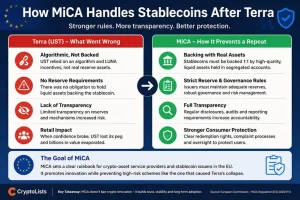
TerraUSD, commonly known as UST, was marketed as a stablecoin. But unlike a fully reserved fiat-backed stablecoin, it relied on an algorithmic relationship with LUNA to maintain its dollar peg. When confidence broke, the mechanism failed, UST lost its peg, LUNA collapsed and billions of dollars in market value disappeared.
That collapse became one of the clearest examples of why regulators wanted stablecoin rules. The issue was not only that users lost money. It was that a product presented as “stable” turned out to depend on fragile incentives, reflexive confidence and a mechanism that could not survive a serious run.
Peter Kerstens, then a senior European Commission official involved in digital finance policy, argued that MiCA would stop similar schemes from coming to market in Europe. His point was that stablecoin issuers would face requirements around authorisation, reserves, white papers, governance and redemption rights.
Crypto Lists view: The EU was right to focus on stablecoins after Terra. A token should not be allowed to market itself as stable without clear information about what backs it, how redemption works and what happens during stress.
MiCA and stablecoins: what changed?
MiCA created specific categories for crypto assets, including asset-referenced tokens and electronic money tokens. In practice, this matters most for stablecoins.
Asset-referenced tokens: These are crypto assets that aim to maintain a stable value by referencing several assets, such as fiat currencies, commodities, crypto assets or a basket of assets.
Electronic money tokens: These are crypto assets that aim to maintain a stable value by referencing one official currency, such as the euro or U.S. dollar.
Under MiCA, issuers in these categories face authorisation, governance, reserve, disclosure and redemption requirements. The European Banking Authority has developed technical standards and guidance around areas such as reserve liquidity, recovery plans, redemption plans, conflicts of interest and reporting.
That is the key difference from the Terra era. A stablecoin issuer cannot simply rely on clever tokenomics and marketing. In the EU, it needs to fit into a regulatory structure or face restrictions.
Did MiCA really prevent Terra-like schemes?
MiCA does not travel back in time and undo Terra. It also cannot stop every risky crypto product from being created somewhere else in the world. But inside the EU regulatory perimeter, it makes Terra-style stablecoin structures much harder to distribute as if they were ordinary stable assets.
The reason is simple: MiCA expects stablecoin issuers to have real governance, reserves, disclosures and redemption arrangements. An algorithmic system that depends mainly on a second volatile token would struggle to satisfy the spirit of those rules.
Crypto Lists answer: Kerstens was directionally right, but the phrase “MiCA prevents Terra” should be understood carefully. MiCA can reduce the chance that a Terra-like product is legally offered to EU users by regulated platforms. It cannot stop offshore speculation, DeFi experiments, self-custody risks or users accessing high-risk products outside the regulated EU market.
MiCA targets NFTs too
The original article noted that MiCA could also affect NFTs. That remains true, but the NFT treatment is more nuanced than saying “all NFTs are regulated like crypto assets”.
MiCA does not generally cover genuinely unique, non-fungible assets in the same way as ordinary crypto assets. However, tokens issued in large collections or series may fall within the rules if they are not truly unique in economic substance. This was the point behind the warning that a project cannot simply call every item an NFT and avoid regulation automatically.
For NFT creators, the lesson is practical. If a project looks like a mass-issued investment product, collectible series or financial asset, regulators may look beyond the label. Marketing claims, rarity promises, revenue-sharing language and secondary-market expectations can all matter.
Crypto Lists view: This is a healthy distinction. A one-off digital artwork and a 10,000-piece speculative collection with investment-style marketing should not automatically be treated the same way.
Increased focus on crypto regulation
The Terra collapse, Celsius, Voyager, FTX and other failures all accelerated global crypto regulation. But Europe’s approach became one of the most comprehensive because MiCA created a single framework across the EU rather than leaving every member state to improvise.
The United States took a more fragmented path, with the SEC, CFTC, banking regulators, courts and Congress all playing different roles. That led to enforcement actions, court battles and delayed federal stablecoin legislation. Europe moved more slowly at first, but MiCA gave the EU a clearer legal framework once it became applicable.
This does not mean MiCA is perfect. Crypto firms still complain about compliance costs, stablecoin restrictions and uncertainty around DeFi. But compared with the pre-MiCA period, the rules for regulated crypto businesses in Europe are much clearer.
MiCA winners and losers
| Likely winners | Likely losers |
|---|---|
| Regulated exchanges with compliance teams | Unregulated offshore platforms targeting EU users |
| Fully backed and authorised stablecoin issuers | Algorithmic stablecoins marketed as safe money |
| Institutional investors seeking clearer rules | Projects relying on vague white papers and hype |
| Users who want better disclosures and redemption rights | Token issuers avoiding reserve and governance checks |
What MiCA does not solve
MiCA is regulation, not insurance. It does not mean every EU-regulated crypto product is safe, profitable or protected like a bank deposit.
Users can still lose money from market volatility, hacks, wallet mistakes, phishing, bad trading decisions, illiquid tokens, smart-contract bugs or offshore platforms. MiCA improves the regulatory perimeter, but it does not remove personal responsibility.
There is also a risk that some users will move to unregulated markets if their preferred stablecoins or products are restricted in Europe. That can reduce protection rather than increase it. Good regulation needs to make safer options usable, not merely push risk elsewhere.
Final view from Crypto Lists
MiCA was one of the first serious attempts to create a full crypto rulebook for a major economic region. Its stablecoin rules were clearly shaped by the lessons of Terra: do not let something call itself stable unless there are real rules behind the promise.
Was the EU official right that MiCA would prevent Terra-like crashes? Mostly, if we are talking about regulated EU distribution. MiCA makes it much harder for a weakly backed or purely algorithmic stablecoin to be offered in Europe as if it were a safe payment token.
But no regulation can stop all speculative behaviour. Terra’s collapse was not only a legal failure. It was also a failure of incentives, risk understanding, marketing, yield chasing and crowd psychology.
For Crypto Lists readers, the practical takeaway is simple: MiCA improves the rules around stablecoins and crypto service providers in Europe, but it does not make crypto risk-free. Always check who issued the token, what backs it, whether redemption is clear, where it is regulated and what could happen in a market panic.
FAQ: MiCA, Terra and stablecoin rules
What is MiCA?
MiCA is the European Union’s Markets in Crypto-Assets Regulation. It creates rules for crypto-asset issuers, stablecoin issuers and crypto-asset service providers operating in the EU.
Did MiCA come into effect?
Yes. MiCA’s stablecoin rules began applying in 2024, and the broader framework for crypto-asset service providers became applicable at the end of 2024, subject to transitional periods in some countries.
Would MiCA have stopped TerraUSD?
MiCA would likely have made it very difficult for a Terra-style algorithmic stablecoin to be marketed and distributed as a regulated stablecoin in the EU. However, it cannot stop every offshore or decentralized experiment.
Does MiCA regulate NFTs?
MiCA generally does not treat genuinely unique NFTs like ordinary crypto assets, but large collections or series may fall within the rules if they are not truly unique in substance.
Does MiCA make stablecoins safe?
No regulation makes stablecoins completely risk-free. MiCA improves disclosures, authorisation, reserves and redemption rules, but users still need to understand issuer risk, platform risk and market risk.