 By Ron S
·📅 29 Dec 2022·🔄 Updated: 11 Jun 2026
Bitcoin Pizza Day is the famous story of how 10,000 BTC was spent on two pizzas in 2010. It sounds funny now, but it also marks one of the most important moments in Bitcoin history: the first widely known real-world purchase using BTC.
Bitcoin began as an experimental peer-to-peer money system. For a long time, it was mostly discussed by cryptographers, programmers and early internet money enthusiasts. Then came the pizza order. A Florida programmer paid 10,000 BTC for two Papa John’s pizzas, and Bitcoin suddenly had something it had never had before: a real-world price tag.
This updated guide looks at Bitcoin’s early history, why the pizza purchase became legendary, how Bitcoin moved from a niche experiment to a global asset, and what players, investors and crypto users can still learn from the story today.
Editor note 2026: We removed the old “pizza for $70m” framing because the exact value changes every day. A more useful way to understand the story is this: the same 10,000 BTC has been worth millions, hundreds of millions and, at times, far more depending on Bitcoin’s market price. The lesson is not the exact number. The lesson is how dramatically Bitcoin’s role has changed.
Humble and Mysterious Origins
Bitcoin appeared during a period of deep distrust in the financial system. The 2008 financial crisis had exposed weaknesses in banks, credit markets and monetary policy. Against that backdrop, a person or group using the name Satoshi Nakamoto published the Bitcoin whitepaper: Bitcoin: A Peer-to-Peer Electronic Cash System.
The whitepaper proposed a system where people could send value directly to one another without relying on banks, card networks or payment processors. Transactions would be recorded on a public blockchain, secured by proof-of-work mining and verified by a decentralised network of participants.
At the time, this was not a mainstream idea. Bitcoin did not arrive with a marketing department, venture capital launch campaign or celebrity founder. It started quietly, with code, forum posts and a small group of people willing to test something completely new.
The first Bitcoin block, known as the Genesis Block, was mined on 3 January 2009. Embedded inside it was a reference to a newspaper headline about bank bailouts. Whether you view that as a political statement, a timestamp or both, it captured the mood of the moment: Bitcoin was created as an alternative to a financial system many people no longer trusted.
Not Necessarily Digital Currency (Yet)
In the earliest days, not everyone agreed on what Bitcoin would become. Some saw it as digital cash. Others were more interested in the cryptography, distributed systems and engineering behind it.
That is common with new technologies. The first use case is not always the final one. Early internet users did not know social media, video streaming and mobile banking would eventually become normal parts of daily life. Bitcoin followed a similar path: first an experiment, then a curiosity, then a tradable asset, then a serious part of global financial debate.
Bitcoin also had a practical problem. If no one accepted BTC as payment, how could anyone know what it was worth?
That is why the pizza story matters. It was not just a funny trade. It was a real-world test of whether Bitcoin could be exchanged for something outside the Bitcoin community.
A Pizza Party
Bitcoin Pizza Day Timeline
2008: Bitcoin whitepaper published.
Jan 2009: Bitcoin network launches.
May 22, 2010: 10,000 BTC spent on two pizzas.
2011: Bitcoin reaches $1.
2013: Bitcoin passes $1,000.
2017: Bitcoin approaches $20,000.
2021: Bitcoin reaches around $69,000.
2024: Bitcoin ETF era begins.
2025–2026: Bitcoin becomes a mainstream institutional asset.
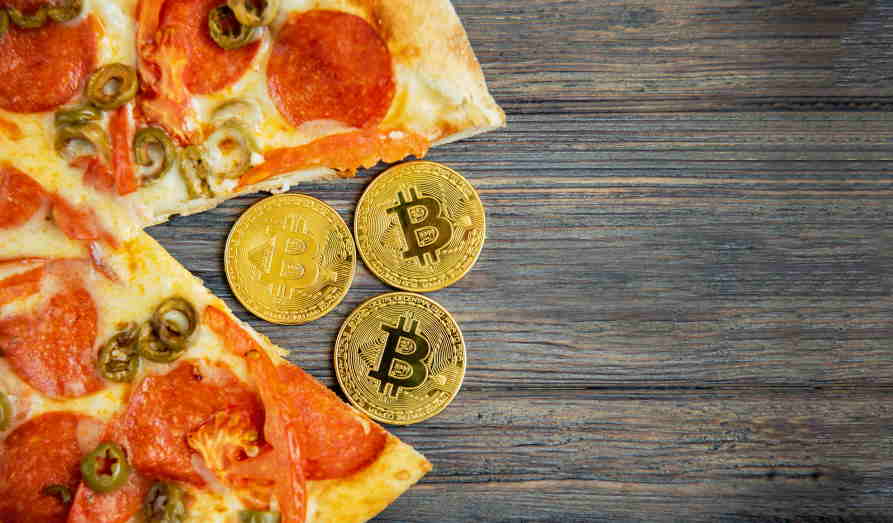
On 22 May 2010, Laszlo Hanyecz paid 10,000 BTC for two pizzas. The transaction became famous because it gave Bitcoin one of its earliest real-world reference prices.
The pizzas were ordinary. The payment was not.
At the time, 10,000 BTC did not feel like a fortune. Bitcoin was still experimental, thinly traded and mostly unknown outside a small technical community. In hindsight, the purchase became legendary because Bitcoin later rose by extraordinary amounts.
Today, Bitcoin Pizza Day is celebrated every year on 22 May. It has become part history lesson, part crypto meme and part reminder that early technology adoption rarely looks obvious at the time.
Why this moment still matters: The pizza purchase showed that Bitcoin could move beyond theory. It could be used in exchange for real goods, even if the process was clunky, informal and far from mainstream adoption.
It is easy to laugh at the trade now. But without early users willing to spend, test and experiment, Bitcoin might never have moved beyond a technical project.
Up, Up and Away
Bitcoin did not become a global asset overnight. After the pizza transaction, it still took time before BTC traded above $1. It then went through repeated cycles of excitement, crashes, recovery and renewed adoption.
Several milestones helped Bitcoin become more visible:
2011: Bitcoin moved above $1 and began attracting wider attention from early crypto users.
2013: Bitcoin passed $1,000 for the first time, showing that demand had moved beyond hobbyists.
2017: Bitcoin entered a major bull market and became part of mainstream financial news.
2020-2021: Institutional interest, pandemic-era liquidity and public company purchases helped push Bitcoin to new highs.
2024: Spot Bitcoin ETFs in the United States and the fourth Bitcoin halving gave the market another major maturity test.
Those milestones do not mean Bitcoin only goes up. It has experienced several brutal drawdowns. But each cycle also expanded the number of people, companies and institutions paying attention.

Supply: 18,925,000 / 21,000,000
Release date: January 3, 2009
Description: Read live Bitcoin prices, facts and market updates.
Risk warning: Trading, buying or selling crypto currencies is extremely risky and not for everyone. Do not risk money that you could not afford to loose.
The Role of the CME Group
A major step in Bitcoin’s financialisation came when CME Group launched Bitcoin futures in December 2017. This gave professional traders a regulated venue for Bitcoin exposure and helped move BTC further into the traditional finance world.
Futures did not make Bitcoin safe or predictable. They did, however, signal that Bitcoin was no longer easy for financial institutions to ignore. A market that once existed mostly on small exchanges and forums was now connected to one of the world’s most important derivatives marketplaces.
This mattered for two reasons.
First: Professional traders could express views on Bitcoin using regulated futures contracts.
Second: Bitcoin became easier to discuss inside institutions that previously saw it as too strange, too small or too informal.
Later developments continued this process. Custody improved, public companies bought Bitcoin, large asset managers entered the discussion and spot Bitcoin ETFs gave investors another route to exposure.
Bitcoin is still volatile, but the market structure around it is far more mature than it was during the pizza era.
Boom and Bust
Bitcoin’s history is not a straight line. It is a series of powerful cycles.
There have been euphoric periods where BTC rose quickly and attracted waves of new interest. There have also been painful bear markets where prices fell sharply and many people declared Bitcoin finished.
That pattern has repeated several times. The 2013 rally was followed by a long downturn. The 2017 bull market was followed by a deep 2018 bear market. The 2021 highs were followed by a difficult period marked by rising interest rates, crypto company failures and reduced investor risk appetite.
Still, Bitcoin survived each major cycle so far. That does not guarantee future returns, but it does show why Bitcoin history matters. Many of the strongest narratives around BTC were formed during difficult periods, not just during bull markets.
The pizza story fits into this pattern. What looked small and experimental in 2010 became symbolic years later because Bitcoin kept surviving long enough for people to reinterpret its early moments.
A Trend Setter
Bitcoin has influenced almost every part of the crypto market.
It introduced the idea of a scarce digital asset secured by proof-of-work. It inspired thousands of later cryptocurrencies. It created new debates about money, decentralisation, custody, mining, privacy, regulation and financial freedom.
It also changed how people think about payments. Before Bitcoin, most digital money systems relied on companies, banks or governments. Bitcoin showed that a peer-to-peer monetary network could operate globally without a central administrator.
That is why Bitcoin Pizza Day remains useful. It is simple, memorable and easy to understand. Two pizzas. 10,000 BTC. A transaction that looked ordinary at the time but became part of financial history.
The lesson is not that everyone should hold forever or never spend Bitcoin. The lesson is that new monetary networks often begin in strange, small and imperfect ways before the world understands what they are.
What Bitcoin Pizza Day Teaches New Crypto Users
Early adoption is messy: The first users of a new technology rarely know exactly where it will go.
Price is not the whole story: The pizza purchase mattered because Bitcoin was used, not only because BTC later became more valuable.
Volatility cuts both ways: Bitcoin’s upside has been dramatic, but its drawdowns have also been severe.
Utility matters: For a currency or network to survive, people must be willing to use, test and build around it.
History helps perspective: Bitcoin has been called dead many times. Understanding its past helps explain why many users still take it seriously.
FAQ: Bitcoin Pizza Day and Early Bitcoin History
When is Bitcoin Pizza Day? Bitcoin Pizza Day is celebrated on 22 May every year. It marks the famous 2010 purchase of two pizzas for 10,000 BTC.
Who bought the Bitcoin pizzas? The purchase is commonly associated with Laszlo Hanyecz, an early Bitcoin user who paid 10,000 BTC for two pizzas.
Why is Bitcoin Pizza Day important? It is one of the earliest widely known examples of Bitcoin being used to buy real-world goods.
Was spending 10,000 BTC a mistake? With hindsight, the trade looks expensive. But at the time, Bitcoin had very little real-world value. The purchase helped prove that BTC could be exchanged for something tangible.
Is Bitcoin still used for payments? Yes, although its role has changed. Some users treat Bitcoin as long-term savings or digital gold, while others use it for payments through wallets, exchanges or Layer 2 systems such as the Lightning Network.