
 By Ron S
·📅 20 Jul 2023·🔄 Updated: 11 Jun 2026
Bitcoin has been the public face of crypto since 2009, but its price does not move in a neat, predictable pattern just because people talk about “four-year cycles”.
The four-year Bitcoin cycle is a useful idea, especially because Bitcoin halvings happen roughly every four years. But it can also be misleading if it is treated like a clock that tells investors exactly when to buy or sell.
This guide explains how Bitcoin cycles work, what the halving actually changes, why older cycle theories should be handled carefully in 2026, and how Bitcoin still influences the wider crypto market.
Important note: This is educational content, not financial advice. Bitcoin is highly volatile. A halving reduces new supply, but it does not guarantee a price increase, a bull market or a repeat of previous cycles.
Go directly to
- 1 Bitcoin Cycles: The Basics
- 2 Bitcoin Cycles: The Basics
- 3 What’s the Deal with Bitcoin “Halving”?
- 4 What Can We Expect Immediately After Halving?
- 5 How Bitcoin Cycles Affect Other Cryptocurrencies
- 6 Are Any Assets Unaffected by Bitcoin Price Movements?
- 7 What Will be the End Result of the Next Halving Event?
- 8 Bitcoin Cycle Myths to Avoid
- 9 FAQ: Bitcoin Four-Year Cycles
Bitcoin Cycles: The Basics
Bitcoin cycles usually refer to the repeated pattern of market interest, price rallies, corrections and recovery phases that have often appeared around Bitcoin halving events.
The simplified version looks like this: Bitcoin goes through a quiet accumulation period, demand grows, prices rise, optimism becomes excessive, early buyers take profit, and the market eventually cools down again.
That pattern has appeared more than once, but it should not be treated as a law of nature. Bitcoin has matured. Spot Bitcoin ETFs, institutional ownership, macroeconomic policy, regulation, stablecoins, leverage and global liquidity all matter far more now than they did during earlier cycles.
| Cycle phase | What often happens | Main risk |
|---|---|---|
| Accumulation | Long-term buyers slowly build positions after a weak market. | Prices can stay flat or fall for longer than expected. |
| Mark-up | Demand improves, media interest returns and price momentum increases. | Late buyers may mistake momentum for certainty. |
| Distribution | Early buyers and large holders may begin taking profit into strength. | Retail investors often enter after much of the move has already happened. |
| Mark-down | Leverage unwinds, sentiment weakens and prices can fall sharply. | Investors may underestimate how deep crypto corrections can be. |
This framework can help explain market psychology, but it should not be used as a trading system on its own. A cycle is a map, not a guarantee.


Supply: 18,925,000 / 21,000,000
Release date: January 3, 2009
Description: Learn the basics of Bitcoin before investing or using BTC.
Risk warning: Trading, buying or selling crypto currencies is extremely risky and not for everyone. Do not risk money that you could not afford to loose.
Bitcoin Cycles: The Basics
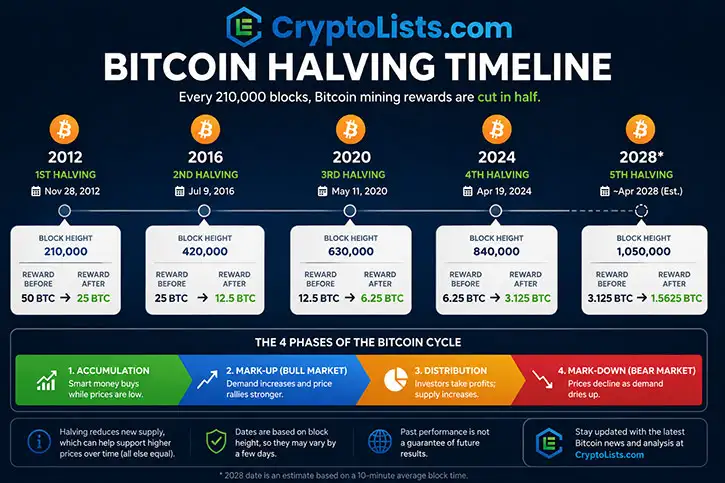
Source: CryptoLists.com Research Team (2026)
Bitcoin halvings have historically occurred approximately every four years. The chart below shows the previous halvings, the current cycle, and the estimated 2028 halving.
What’s the Deal with Bitcoin “Halving”?
A Bitcoin halving is an automatic event built into Bitcoin’s rules. Roughly every 210,000 blocks, the block subsidy paid to miners is cut in half.
The most recent halving happened at block 840,000 in April 2024. It reduced the block subsidy from 6.25 BTC to 3.125 BTC. The next halving is expected around 2028, when the subsidy should fall from 3.125 BTC to 1.5625 BTC.
The reason this matters is simple. Bitcoin has a fixed issuance schedule. New BTC enters circulation through mining rewards, and halvings slow the rate at which new coins are created.
However, a halving does not directly change demand. It only changes new supply. If demand is weak, overleveraged or already priced in, the market can still disappoint. If demand is strong, reduced issuance can become more important over time.
For readers who want to check the mechanics, the Bitcoin white paper explains the original peer-to-peer cash design, while the current supply schedule can be verified through Bitcoin block data and public blockchain explorers.
What Can We Expect Immediately After Halving?
The honest answer is: not as much as many people expect.
Bitcoin halvings are known in advance. Traders, miners, funds and market makers are not surprised when they happen. That means the event itself can be partly priced in before the block is reached.
Historically, Bitcoin’s strongest moves have not always happened immediately after a halving. The bigger market shifts have often developed over months, influenced by liquidity, risk appetite, ETF flows, miner behaviour, interest rates and general market sentiment.
What changed in 2024? The 2024 halving was different because spot Bitcoin ETFs had already created a new source of demand in the United States. That made the cycle less comparable with 2012, 2016 or 2020.
What could still go wrong? Regulation, recession fears, exchange failures, excessive leverage, miner selling, geopolitical shocks or falling liquidity can all overpower the halving narrative in the short term.
Editor note: The most useful way to view the halving is not as a price prediction tool. It is a supply event that may matter more when combined with strong demand.
How Bitcoin Cycles Affect Other Cryptocurrencies
Bitcoin still acts as the emotional centre of the crypto market.
When Bitcoin rises strongly, traders often become more willing to take risk in Ethereum, Solana, Litecoin, Dogecoin, AI tokens, gaming tokens and smaller altcoins. When Bitcoin falls sharply, many of those assets fall even harder.
This is often described as crypto correlation. It does not mean every coin moves exactly like Bitcoin. It means Bitcoin’s trend often influences the level of confidence across the whole market.
There are several reasons for this.
Liquidity: Bitcoin is usually the first crypto asset institutions and large investors look at.
Market psychology: A strong Bitcoin chart often improves sentiment across crypto.
Trading pairs: Many crypto traders still use BTC as a reference point for valuing the rest of the market.
Risk appetite: If investors are afraid to hold Bitcoin, they are usually even less willing to hold smaller tokens.
For crypto casino players, this can also matter in a practical way. A player depositing BTC, LTC, ETH or USDT may experience very different balance behaviour depending on whether they hold volatile coins or stablecoins between sessions.
Are Any Assets Unaffected by Bitcoin Price Movements?
Very few crypto assets are completely unaffected by Bitcoin.
Older versions of this article suggested that assets such as Chainlink, Cosmos or Tezos could sometimes behave independently. In practice, that is only partly true. Individual tokens can outperform or underperform Bitcoin for long periods, but during major crypto sell-offs, correlation often rises.
That is one reason stablecoins became so important. USDT and USDC are not designed to rise with Bitcoin. They are designed to track the value of fiat currencies, usually the US dollar. This makes them useful for traders and casino players who want crypto payment rails without taking the same price volatility as BTC.
Still, stablecoins have their own risks, including issuer risk, regulatory risk and depegging risk. They are not the same as holding cash in a bank account.
The practical lesson is simple: if Bitcoin falls hard, most crypto assets are likely to feel it. Some may fall less, some may recover faster, but very few are truly isolated from Bitcoin sentiment.
What Will be the End Result of the Next Halving Event?
The next halving is expected around 2028. By then, Bitcoin will be a more mature asset than it was during earlier cycles.
That could make the next cycle more interesting, but also harder to predict. A larger market can attract more capital, but it can also produce smaller percentage gains than early Bitcoin cycles. Institutional participation may reduce some chaos while adding new sources of volatility through ETFs, derivatives and macro-driven flows.
The strongest bullish argument is that Bitcoin’s new supply continues to shrink while global awareness and financial infrastructure continue to grow.
The strongest bearish argument is that everyone already knows about the halving, and markets rarely reward simple narratives forever.
Our view is that Bitcoin cycles still matter, but they should be treated with humility. The halving is real. The supply schedule is real. The four-year pattern is historically interesting. But price outcomes still depend on demand, liquidity, regulation, adoption, leverage and investor behaviour.
If you use Bitcoin cycles as a learning tool, they are useful. If you use them as a guaranteed trading calendar, they can become dangerous.
Bitcoin Cycle Myths to Avoid
Myth 1: Bitcoin always peaks at the same time after halving. It does not. Previous cycles can rhyme, but they do not repeat exactly.
Myth 2: The halving instantly makes Bitcoin more valuable. The halving reduces new supply. It does not force demand to rise.
Myth 3: Altcoins always follow Bitcoin in the same way. Some altcoins outperform during risk-on markets, but many collapse when liquidity disappears.
Myth 4: Four-year cycles remove risk. They do not. Bitcoin can still fall sharply inside a supposedly bullish cycle.
FAQ: Bitcoin Four-Year Cycles
What is a Bitcoin four-year cycle? It is the common name for Bitcoin’s repeating market pattern around halvings, which happen roughly every four years. The pattern includes accumulation, rallies, profit-taking and corrections, but timing is never guaranteed.
When was the last Bitcoin halving? The last halving occurred in April 2024 at block 840,000, reducing the block subsidy from 6.25 BTC to 3.125 BTC.
When is the next Bitcoin halving? The next halving is expected around 2028, at block 1,050,000. The exact date depends on block production speed.
Does Bitcoin always rise after a halving? No. Bitcoin has historically performed well in some post-halving periods, but the halving alone does not guarantee higher prices.
Do Bitcoin cycles affect crypto casinos? Indirectly, yes. Bitcoin price movements can influence player behaviour, deposit preferences and whether users choose volatile coins like BTC or stablecoins such as USDT and USDC.
Should beginners trade based on Bitcoin cycles? Beginners should be careful. Cycles can help explain market structure, but they are not a substitute for risk management, research or professional financial advice.