
·📅 14 Sep 2022·🔄 Updated: 12 Jun 2026
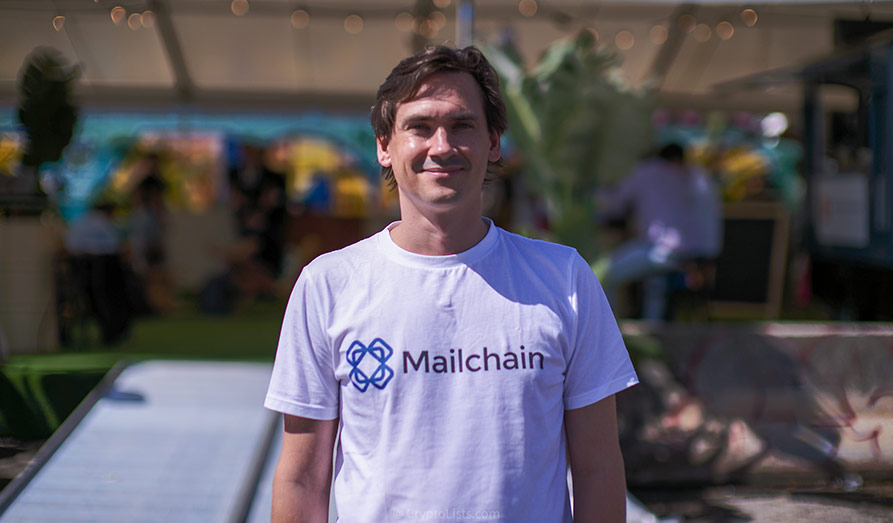
Crypto Lists originally interviewed Tim Boeckmann, CEO of Mailchain, during the NEARCON 2022 period. At the time, Mailchain looked like one of the more practical ideas in Web3: an encrypted inbox where people could communicate using blockchain identities instead of exposing ordinary email addresses.
Important 2026 update: Mailchain has since announced that the Mailchain protocol and associated services, including app.mailchain.com, will be permanently discontinued on 5 May 2026. That changes how this article should be read. It is no longer a “try this today” recommendation. It is now a preserved Crypto Lists interview and first-hand test of a Web3 communication project that tried to solve a real problem but did not become a permanent infrastructure layer.
Update (June 2026): Mailchain officially ceased operations on 5 May 2026. The service and user accounts are no longer available. This interview has been preserved as a historical case study documenting one of the more ambitious attempts to build encrypted wallet-based communication for Web3 users.
We are keeping and updating this interview because it contains something many old crypto articles do not: real product testing by Crypto Lists, direct founder answers, practical privacy questions, and specific feedback that the Mailchain team fixed quickly during our test.
Go directly to
- 1 Why this Mailchain interview still matters
- 1.1 How did you come up with the idea of Mailchain?
- 1.2 Can you tell us a bit about your background?
- 1.3 What about the privacy risks with encrypted emails?
- 1.4 What does it cost to use Mailchain?
- 1.5 What will it cost with pictures?
- 1.6 Is it based on its own blockchain? The Near blockchain?
- 1.7 Which layers exist with Mailchain?
- 1.8 Did Mailchain get any venture capital?
- 1.9 Is the email stored in an encrypted format in the blockchain?
- 1.10 Why use Mailchain instead of your normal email?
- 1.11 Which group of people may use Mailchain the most?
- 1.12 Can you only send emails to mailchain.com addresses?
- 1.13 Will Mailchain improve the interface on mobile?
- 1.14 Will you be able to add Mailchain to Gmail, Outlook or any other email client?
- 1.15 Is my Mailchain account name taken or not?
- 2 What Mailchain’s shutdown says about Web3 communication
- 3 FAQ: Mailchain and Web3 email
Why this Mailchain interview still matters
Most crypto applications are built around wallets, swaps, NFTs, DeFi positions and governance. But one basic internet function has always been awkward in Web3: communication.
If a DAO needs to contact voters, if a DeFi project needs to send a security notice, or if a collector wants to message another wallet owner, there is no universal inbox attached to a blockchain address. Projects often ask users for email addresses, Discord accounts, Telegram handles or phone numbers. That can work, but it weakens the idea of pseudonymous blockchain identity.
Mailchain tried to solve that gap by creating a Web3 inbox for encrypted communication between blockchain identities. According to Mailchain’s own documentation, the platform was designed as both an open-source multi-chain protocol for encrypted messages and a unified inbox for wallet-based communication.
Crypto Lists view: The idea was good. The shutdown does not mean the problem was fake. It means Web3 communication remains hard: identity, privacy, storage, spam control, usability, key recovery and business-model sustainability all have to work at the same time.
How did you come up with the idea of Mailchain?
Tim Boeckmann: In 2018 and 2019, when many were sending crypto assets and collectibles, nobody was sending encrypted messages or messages at all. So I played around. I saw the use cases for a Web3 communication layer increase, and continued to explore a way for anyone to be able to send private messages. In December 2021, we started to work on the project.
Crypto Lists update: This answer remains the core reason the interview is worth preserving. Tim identified a real weakness in blockchain UX: wallets could hold value, NFTs and identity, but they could not easily receive private, contextual messages.
Can you tell us a bit about your background?
Crypto Lists asked: How come you created Mailchain and focused on Web3’s communication layer?
Tim Boeckmann: I think this route chose me. In 2006 I started working for an ISP and saw the evolution of their platform going into the cloud. Then I was at Amazon Web Services in charge of emerging technology startup strategy. During my years with Amazon Web Services I worked with 3,000 to 4,000 startups.
Tim continued: With blockchain startups, a question that kept coming up was: how do they send messages? There are many social challenges with that. Many people and businesses want to have communication separated from their traditional email address, and to have it contextualized with their blockchain wallet address. People even send NFTs with contact details in them so creators or collectors can communicate with other collectors.
Crypto Lists context: Tim’s background is one reason the interview was more interesting than a normal project announcement. Mailchain came from someone who had worked around cloud infrastructure and startups, not only from a token-marketing team.
What about the privacy risks with encrypted emails?
Tim Boeckmann: With Mailchain, all information is encrypted. When you register an existing blockchain address, Mailchain works on the app level to derive a messaging key that is unique to that address. So you don’t need to add any private keys. Your identity is like a keyring that has keys only you can see. This means your Mailchain identity, your keys and your messages are your data, encrypted, and only you have access.
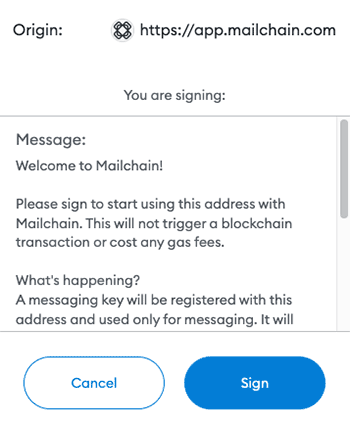
2026 privacy note: Mailchain’s documentation described end-to-end encryption by default, with messages encrypted in the browser before storage. It also stated that Mailchain could not decrypt user messages. That is the right design direction for a Web3 inbox, but users should still remember that encrypted communication systems depend on key management, recovery flows, device security and the long-term survival of the service provider.
What does it cost to use Mailchain?
Tim Boeckmann: Everything is free today. Anyone can send messages in a private way, up to a certain quota. Currently, that quota is 25 messages a day. We are testing and experimenting at the moment.
Crypto Lists update: This was one of the open questions around Mailchain from the start. Free encrypted messaging is attractive for users, but infrastructure still costs money. Storage, transport, development, security work and support all need funding. The eventual shutdown is a reminder that useful Web3 infrastructure still needs a sustainable business model.
What will it cost with pictures?
Crypto Lists asked: My experience is that attachments such as images take up a lot of storage.
Tim Boeckmann: Yes, you are right. We currently work with a soft-limit quota of 25 messages per day, but it can change over time. The free tier will fall under Mailchain governance. We will work on keeping costs down. If you send a lot of encrypted Web3 messages, you are probably prepared to pay for it.
Tim continued: You can send up to 25 group messages and use your quota for that. We aim to have a cost below half a cent. Storage costs are going down. Mailchain does not want currency volatility to impact fees and will work hard to minimise any kind of fees. But if someone is providing infrastructure, they need to cover their costs.
Crypto Lists view: This was a fair answer. It also highlights a problem many Web3 products face: users want decentralization, encryption and low fees, but they often expect consumer-grade usability and free infrastructure at the same time.
Is it based on its own blockchain? The Near blockchain?
Tim Boeckmann: It’s possible for Mailchain to work with all blockchains. When you look at NEAR dApps and communities, they need to communicate. That’s why we are here.
Mailchain was not presented as a NEAR-only project. NEARCON gave the team access to NEAR builders and potential partners, but the concept was broader: a communication layer for blockchain identities across ecosystems.
Which layers exist with Mailchain?
Mailchain was described around three main components:
Registry layer: This handled encryption keys and addressing. A user could set preferences, such as how long messages should be stored or where they could be sent.
Transport layer: This was responsible for moving encrypted messages between sender and recipient.
Storage layer: Once the message had been encrypted in the client and stored, the storage location and message metadata were also encrypted, then sent and stored.
Crypto Lists explanation: The important detail is that Mailchain did not aim to store emails directly on-chain. That would be expensive, permanent and usually bad for privacy. The more sensible model was encrypted off-chain or distributed storage, with blockchain identities used for addressing and keys.
Did Mailchain get any venture capital?
Tim Boeckmann: Yes. A blockchain technology VC group from Hong Kong called Kenetic Capital and a London-based seed-stage investor, Crane Venture Partners, led the recent 3.9 million GBP investment. The money will go to improving the interface and adding more partners. Not so much will go on marketing, since we identify who really needs messaging and go and work directly with those users and projects.
Crypto Lists update: Public funding databases later described Mailchain’s 2022 seed raise as approximately 4.6 million USD, led by Crane Venture Partners and Kenetic Capital. The exact currency conversion is less important than the broader point: Mailchain had credible early backing, but funding alone does not guarantee long-term product survival.
Is the email stored in an encrypted format in the blockchain?
Crypto Lists asked: Or where is it stored?
Tim Boeckmann: It is stored in an encrypted format on distributed decentralized storage. We are discussing with another partner in order to add more alternatives for our users. Emails are never stored on-chain. We don’t want them to be stored forever.
Crypto Lists view: This was one of the strongest technical answers in the interview. Storing private messages permanently on a public blockchain would create obvious privacy and data-retention problems. For encrypted messaging, “not everything belongs on-chain” is usually the more mature answer.
Why use Mailchain instead of your normal email?
Tim Boeckmann: Normal email users are not the primary users of Mailchain. The strongest use cases are where Web3 projects and users need to send messages to other users. Some examples can be announcements, receipts, invoices, governance updates, general statements, security-related announcements, offers and promotions. Mailchain is focused on interaction with Web3, where the users get the most value.
Crypto Lists comment: This distinction still matters. Mailchain was not trying to replace Gmail for normal family emails. It was trying to solve wallet-context communication: messages connected to blockchain activity, wallet ownership, community participation and on-chain identity.
Which group of people may use Mailchain the most?
Tim Boeckmann: Those into gaming, different types of collectors and the DeFi world.
Crypto Lists view: Those were logical target groups. NFT collectors, DAOs, DeFi users and gaming communities often need to receive project-specific updates without linking a traditional email address everywhere. The challenge is that these groups also live heavily in Discord, Telegram, X and wallet notifications, making behavior change difficult.
Can you only send emails to mailchain.com addresses?
Markus from Crypto Lists asked: When testing with [email protected], I only managed to send to mailchain.com addresses. Is that correct?
Tim Boeckmann: You can also send emails to Ethereum-compatible blockchain wallet addresses, and will be able to send to .ETH, .NEAR and more soon.
Crypto Lists test note: This was one of the useful parts of our original hands-on test. We did not only ask what Mailchain could do in theory; we created a Mailchain address and tried the product ourselves. At the time, the experience still felt early, especially around cross-identity addressing.
Will Mailchain improve the interface on mobile?
Crypto Lists asked: We learnt that you are in beta still, and from Crypto Lists tests today, Mailchain is not working optimally on mobile yet. Is that something that your team is working on? When my colleague tested Mailchain on an iPhone 12, he could only see the “from” field, and not the “sending to” field.
Tim Boeckmann: Thanks for the feedback. We’ll have it sorted by tomorrow.
Update from Crypto Lists: This was adjusted in less than 14 hours, which was genuinely impressive. It showed that the team was listening closely to early product feedback.
2026 note: This is exactly the kind of detail worth preserving in an old interview. It is first-hand, specific and test-based. Even though the product later announced discontinuation, the response speed during the beta test was a positive signal at the time.
Will you be able to add Mailchain to Gmail, Outlook or any other email client?
Tim Boeckmann: There are a lot of standards out there. You will certainly be able to add Mailchain to some of them one day. We are happy to integrate any email providers when they look at Web3 integrations. Currently, not so many are working on email solutions for Web3.
Crypto Lists view: Integrating with normal email clients would have helped user adoption, but it also would have added complexity. Web3 messaging had to compete not only with other crypto tools, but with decades of email habits.
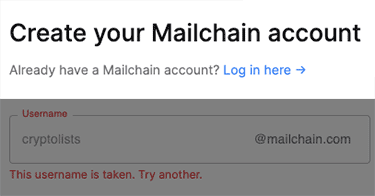
Is my Mailchain account name taken or not?
Crypto Lists asked: I know that the registration function was just released. However, I find it a bit confusing to see if an email address on Mailchain is taken or not. When clicking continue, Mailchain says that my username is taken. But from my understanding, I grabbed the name and handle it now. Right?
Tim Boeckmann: Thanks for showing me that. We will work on the user interface to make it clearer.
Update from Crypto Lists: The interface became clearer quickly, and it was simple to see when a new address was registered.
What Mailchain’s shutdown says about Web3 communication
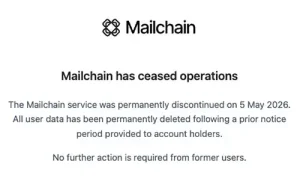
Mailchain announced the permanent discontinuation of its services on 5 May 2026.
Mailchain’s discontinuation does not make the original idea meaningless. It makes the case study more useful. Web3 still lacks a universal, user-friendly way to communicate with wallet owners while preserving privacy and avoiding spam.
In hindsight, Mailchain was trying to solve several hard problems at the same time: encrypted messaging, wallet identity, cross-chain addressing, distributed storage, user onboarding, mobile UX, spam prevention, developer adoption and long-term infrastructure funding.
Crypto Lists final view: The need for private wallet-based communication still exists. Mailchain showed one serious attempt to solve it. The shutdown is a reminder that even well-funded, technically thoughtful Web3 infrastructure can struggle if the user habit, monetization model and ecosystem timing do not line up.
Crypto Lists thanks Tim Boeckmann for taking the time to answer our original questions and for responding quickly to our early product feedback. Readers should not treat this article as a current recommendation to open a Mailchain account. Instead, it should be read as an archived interview and practical case study from the early Web3 communication era.
FAQ: Mailchain and Web3 email
What was Mailchain?
Mailchain was a Web3 communication project designed to let users send and receive encrypted messages using blockchain identities and wallet addresses.
Is Mailchain still operating?
Mailchain announced that its protocol and associated services, including app.mailchain.com, would be permanently discontinued on 5 May 2026.
Did Crypto Lists test Mailchain?
Yes. Crypto Lists created [email protected] and tested the early product, including registration, sending behavior and mobile interface issues during the beta period.
Were Mailchain messages stored on-chain?
No. According to Tim Boeckmann, emails were not stored directly on-chain. They were stored in encrypted format using distributed decentralized storage.
Why does Web3 need encrypted messaging?
Wallet-based communication can help projects send receipts, governance updates, security notices and community messages without forcing users to expose ordinary email addresses or phone numbers.