

·📅 1 Sep 2022·🔄 Updated: 12 Jun 2026
Crypto adoption in the Dominican Republic is not only about trading coins online. For many users, the real question is simpler: how do you move between Dominican pesos, U.S. dollars, Bitcoin, USDT and bank accounts in a safe and practical way?
That is where local OTC desks and exchange partners become important. In 2022, Crypto Lists met Sara Negron, founder of CryptoPay, at a crypto conference in Barcelona. Her company focused on helping Dominican users buy and sell crypto through local fiat routes, bank transfers and OTC-style service.
2026 update: CryptoPay appears to remain active in the Dominican Republic under the CryptoPay.trade brand, with recent social media activity focused on exchange houses, real estate companies, importers and local businesses that need crypto-to-fiat liquidity. Crypto Lists has not recently tested a full transaction, so this article should be read as a country guide with interview insights rather than a fresh review.
Go directly to
- 1 Why crypto matters in the Dominican Republic
- 2 How Dominicans buy and sell crypto
- 3 Interview insight: Sara Negron and CryptoPay
- 4 Why stablecoins are important locally
- 5 The role of exchange houses
- 6 What users should check before using an OTC crypto service
- 7 Crypto regulation in the Dominican Republic
- 8 What changed since the original CryptoPay interview?
- 9 Final view from Crypto Lists
- 10 FAQ: Crypto in the Dominican Republic
Why crypto matters in the Dominican Republic
The Dominican Republic is a dollar-aware economy. Many people think in both Dominican pesos and U.S. dollars, especially when dealing with property, imports, savings, travel, remittances or international business.
That makes crypto, especially stablecoins such as USDT and USDC, more relevant than it may first appear. The main use case is not always “buy Bitcoin and get rich”. In many cases, people want faster access to digital dollars, easier international transfers, or a way to move value outside slow banking rails.
Crypto Lists view: The most interesting part of Dominican crypto adoption is the connection between local cash businesses, exchange houses, stablecoins and OTC desks. This is much more practical than the usual crypto hype about metaverse coins or short-term trading.
How Dominicans buy and sell crypto
There are several routes into crypto in the Dominican Republic. Some users rely on global exchanges. Others use peer-to-peer deals, local brokers, WhatsApp contacts or OTC desks. For larger or more practical fiat transactions, local exchange-style services can be more convenient than trying to move money through an international exchange.
OTC desks: These are services that help users buy or sell crypto directly, often with bank transfer, cash, pesos or dollars involved.
Stablecoins: USDT and USDC are often more practical than volatile crypto when users mainly want digital dollar exposure.
Bitcoin: Bitcoin remains important as the main long-term crypto asset, but for daily fiat conversion, stablecoins may be more commonly used.
Exchange houses: CryptoPay’s recent marketing suggests a focus on casas de cambio, which makes sense. These businesses already understand currency exchange, liquidity and local customer trust.
Interview insight: Sara Negron and CryptoPay
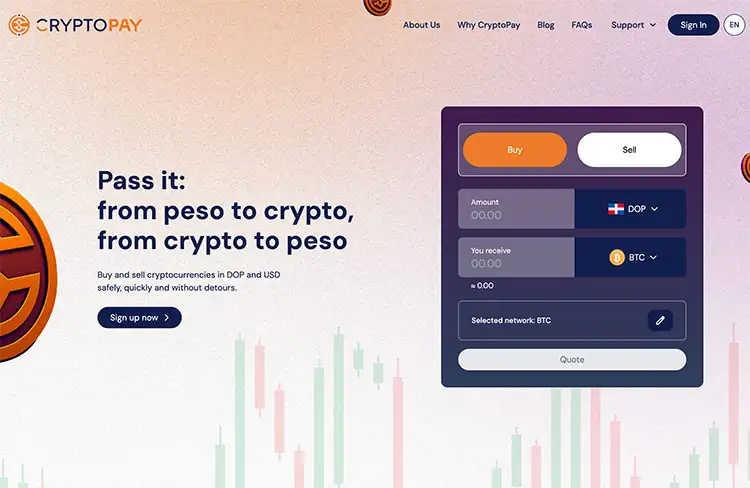
When Crypto Lists interviewed Sara Negron, she described CryptoPay as a Dominican Republic-based crypto OTC desk where users could exchange crypto into fiat and fiat into crypto in an easier and safer way.
At the time, CryptoPay supported crypto transactions involving BTC, USDT, USDC and BUSD. Since BUSD is no longer as relevant as it was during the original interview period, users should verify current supported assets directly with CryptoPay or any local provider before sending funds.
Sara explained that users completed registration and KYC, transferred funds to CryptoPay’s bank accounts or wallets, and then received the corresponding crypto or fiat after confirmation. The commission mentioned at the time was around 3%.
Crypto Lists note: That fee may or may not be current. Always confirm the fee before sending money. For OTC services, the most important details are the final exchange rate, commission, settlement time, official payment details and support channel.
Why stablecoins are important locally
In many Latin American and Caribbean markets, stablecoins are often more useful than people in Europe or the United States realise. They can act as digital dollars, help with international payments, and make it easier to move value between people, businesses and platforms.
For Dominican users, the most practical stablecoin use cases may include savings in digital dollars, business payments, import-related transfers, real estate transactions, remittances and moving between pesos and international crypto markets.
That does not mean stablecoins are risk-free. Users still need to understand issuer risk, platform risk, fake wallet addresses, phishing, blocked transactions and changing regulation.
Crypto Lists view: Stablecoins are probably more important to day-to-day crypto adoption in the Dominican Republic than most altcoins. Bitcoin gets the attention, but USDT and USDC may solve more immediate payment and liquidity problems.
The role of exchange houses
CryptoPay’s recent social media focus on casas de cambio is interesting. Instead of trying to replace local exchange houses, the strategy appears to be helping them serve customers who want crypto liquidity.
That is a smart local angle. A traditional currency exchange shop already has foot traffic, trust, cash handling experience and knowledge of DOP/USD conversion. Adding crypto liquidity could allow those businesses to serve customers who want to buy or sell digital dollars, Bitcoin or other crypto assets.
This model also fits the Dominican market better than a purely online exchange approach. Many users still prefer speaking with a person, confirming details directly, and using familiar local payment methods.
What users should check before using an OTC crypto service
Company identity: Check the legal company name, website, social profiles and official contact details.
Fees and exchange rate: A low commission means little if the exchange rate is poor. Always compare the final amount received.
Supported assets: Confirm whether the service currently supports BTC, USDT, USDC, DOP, USD or other currencies.
KYC requirements: Serious OTC desks usually require identity checks, especially for larger transactions.
Settlement time: Ask whether the quoted timing applies to first-time users, large transactions and bank transfers.
Official payment details: Never send funds based only on a DM, Telegram message or copied bank account number.
Crypto regulation in the Dominican Republic
The Dominican Republic has not become a global crypto regulation hub in the same way as the European Union, Dubai or Singapore. That means users need to be especially careful when dealing with local services.
A lack of aggressive regulation does not mean a service is unsafe. It also does not mean it is protected. The practical approach is to verify each provider, avoid rushed transfers, keep records and use official channels only.
For businesses, compliance matters even more. Any company handling crypto-to-fiat flows should think about KYC, anti-money-laundering rules, accounting, tax reporting and banking relationships.
What changed since the original CryptoPay interview?
Several things changed after the original interview. Stablecoins became even more central to crypto adoption. BUSD lost relevance. LocalBitcoins shut down. Global exchanges increased KYC and compliance controls. Bitcoin ETFs made Bitcoin more mainstream, while regulators became more serious about stablecoins and crypto payment rails.
CryptoPay also appears to have shifted its public branding toward CryptoPay.trade, with messaging aimed at Dominican exchange houses, real estate companies, import businesses and people who want to move from pesos to crypto or crypto to pesos.
Crypto Lists observation: This makes the article more useful today, not less. It shows how a local crypto company can evolve from a consumer OTC desk into a liquidity partner for businesses that already handle currency movement.
Final view from Crypto Lists
Crypto adoption in the Dominican Republic is best understood through practical needs: pesos, dollars, stablecoins, remittances, exchange houses, property transactions and local trust.
Sara Negron’s original interview remains useful because it captured a local perspective that many global crypto articles miss. Crypto is not adopted the same way everywhere. In the Dominican Republic, OTC desks and exchange-house partnerships may matter more than yet another global trading app.
Crypto Lists has not recently tested CryptoPay with a live DOP-to-crypto or crypto-to-DOP transaction. Because of that, readers should verify current fees, supported assets, KYC rules, transaction limits and official contact details before using the service.
Please note: CryptoPay.do, CryptoPay.trade and CryptoPay, SRL should not be confused with CryptoPay.me or other similarly named crypto payment businesses.
FAQ: Crypto in the Dominican Republic
Is crypto popular in the Dominican Republic?
Crypto has a growing local presence, especially around Bitcoin, stablecoins, OTC desks and services that help users move between Dominican pesos, U.S. dollars and digital assets.
Why are stablecoins useful in the Dominican Republic?
Stablecoins such as USDT and USDC can give users digital dollar exposure and may help with transfers, savings, business payments and international transactions. They still carry issuer, platform and regulatory risks.
What is CryptoPay?
CryptoPay is a Dominican crypto service originally described to Crypto Lists as an OTC desk for exchanging crypto into fiat and fiat into crypto. Its newer branding appears focused on CryptoPay.trade and local business liquidity.
Did Crypto Lists test CryptoPay?
Crypto Lists met Sara Negron in person and interviewed her about CryptoPay, but this article does not claim a recent 2026 transaction test.
What should users check before using a Dominican OTC crypto desk?
Users should verify company identity, fees, exchange rates, supported assets, KYC requirements, bank details, official contact channels and settlement times before sending funds.