
·📅 22 May 2026
The crypto casino industry has grown quickly over the last few years, but unfortunately, so has the number of questionable gambling sites targeting unsuspecting players.
While many crypto casinos operate professionally and process withdrawals quickly, others are designed mainly to collect deposits, delay payouts, or disappear entirely after gaining enough traffic and players.
At CryptoLists, we regularly investigate suspicious casinos, failed withdrawals, fake licenses, and misleading marketing practices. Our main warnings page already tracks many casinos and exchanges that we believe you should approach with caution.
But how can you spot the warning signs before depositing? Here are 10 major red flags that may indicate a crypto casino is unsafe, unreliable, or potentially a scam.
Go directly to
- 1 No Real License Details
- 2 Withdrawal Delays Without Explanation
- 3 Sudden KYC Requests After Winning
- 4 Many Fake Reviews and Unrealistic Ratings
- 5 Bonuses That Sounds Too Good to be True
- 6 No Transparency About Ownership
- 7 Poor or Non-Existent Customer Support
- 8 Manipulated Games or Unknown Providers
- 9 VPN and Restricted Country Traps
- 10 A History of Complaints or Scam Accusations
No Real License Details
One of the biggest warning signs is fake or unverifiable licensing details. Some of the typical warning signs include those that display fake license numbers, claim to be fully licensed without naming the regulator or mention having a license from jurisdictions such as Costa Rica that doesn’t issue gambling licenses.
Others may claim to hold licenses that cannot be verified in public registers. Most jurisdictions have a clickable logo that casinos are supposed to have on the site, usually in the bottom part of the page. If that isn’t there or if you cannot click on it to verify the license status, they usually don’t have a license.
While we do the job in all our reviews to verify licenses, it’s good if you always check the license number, the regulator website, the company information and whether the license is still active.
Warning: Even licensed crypto casinos can carry risks. Some offshore jurisdictions have historically offered lighter regulatory oversight and weaker player protection systems compared to stricter European markets. For example, older Curaçao licenses were often criticized for limited dispute resolution and weak enforcement. However, Curaçao has introduced major regulatory changes in recent years, including a new licensing structure and stricter compliance requirements for the casinos. See a list of the top rated brands from Curacao here.
Anjouan licenses are generally much cheaper and easier to obtain, which means standards can vary significantly between casinos. While some Anjouan-licensed casinos operate professionally, others may provide limited transparency, weak customer support, or unclear complaint procedures. The ABC News reportage from December 2025 claim that the a network of companies has been selling Anjouan gambling and financial licenses that local authorities in Comoros describe as “fictitious” and operating illegally, with little or no real regulatory oversight.
This is why players should never rely on a license alone. It’s also important to look at factors such as withdrawal history, company transparency, public reputation, customer support quality, and how the casino handles verification and disputes to get a better picture.
Withdrawal Delays Without Explanation
A professional crypto casino usually processes withdrawals quickly. 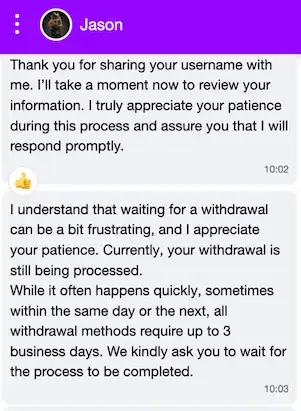 We tend to expect an approved cashout within a few minutes for the really good ones, and a few hours for the smaller or less reputable ones. But please remember that night during night time, there might be approval delays so don’t stress it too much if a withdrawal at 2 AM is not processed within 1-2 hours. If the withdrawal process is not automated, they will likely handle it when the team is back at work in the morning.
However, warning signs such as “pending status” for several days or repeated requests to wait a bit longer might be signs of scammers. If the support gives vague answers about your withdrawal and can’t handle it in 10 minutes, it’s usually a really bad indication. Another bad alert is when withdrawals suddenly require verification after winning a significant sum. In the example to the right, we actually got the payout within 24 hours and they promise cashout within 3 days.
Delayed payouts are one of the most common complaints we see from crypto players, that often expect really fast cashouts. While there can be exceptions such as long holiday weekends or changed withdrawal methods delaying the process, the best brands are usually prepared for everything.
Sudden KYC Requests After Winning
Some casinos advertise themselves as “no KYC” or “anonymous”, only to suddenly demand passports, selfies, proof of address and source of funds in some cases after a player wins a larger amount. While verification is sometimes legally required if they suspect bonus abuse, underage gambling or using another persons identity, changing the rules after deposits or winnings is a major red flag.
Make sure to always read the KYC policy, withdrawal rules, bonus terms and restricted country clauses before depositing. We try to point those things out in the reviews, but terms can change over time.
Many Fake Reviews and Unrealistic Ratings
If every review sounds overly positive and generic, be extra careful. Suspicious patterns include hundreds of similar 5-star reviews, no negative feedback at all, copied review text, fake Trustpilot-style widgets and AI-generated testimonials. No casino has perfect feedback from every player. Real casinos usually have a mix of positive experiences, complaints, payment issues, bonus disputes and support criticism.
Bonuses That Sounds Too Good to be True
Huge bonuses that almost sounds too good to be true are often used to attract inexperienced players. 500% bonuses in the welcome package are usually attached to high wagering requirements or restricted payout conditions. Be cautious if a site offers unrealistic welcome bonuses, “guaranteed profits”, impossible cashback offers or they hide the very high wagering requirements and bonus conditions. Some scam casinos intentionally make bonus terms nearly impossible to complete.
No Transparency About Ownership
Many suspicious or generally secretive no KYC casinos hide company names, management, operator details and physical location. We’re usually very negative towards those, unless we know the people behind and tested deposits and withdrawals multiple times to verify so they work.
Some of the less transparent brands constantly change domains or brands names after building a negative reputation. A trustworthy licensed casino should at least provide company information, terms and conditions, support details and licensing data. If they don’t show any of that in the terms and conditions or mention something about their lack of license in the FAQ, it’s usually a bad sign.
Poor or Non-Existent Customer Support
Before depositing, test the support yourself. We always do exactly that here, often from at least two different countries. Red flags include no live chat or it’s impossible to reach the support. Multiple copy-paste answers or that the support ignore withdrawal questions is two other bad signs. Further, we found that casinos with extremely slow response times and no real human interaction are more likely to be scammers than those that reply to questions in a professional manner. But make sure to reach the support during their opening hours, since all doesn’t have 24/7 live chat support.
Reliable support becomes especially important if withdrawals get delayed, accounts are restricted or if verification problems appear.
Manipulated Games or Unknown Providers
Legitimate crypto casinos usually work with multiple well-known game providers such as Evolution, Pragmatic Play, BGaming, NetEnt and Playtech to name a few. We’re usually a bit extra cautious if many providers are unknown, RTP information is missing or impossible to find and if games behave suspiciously. Other red flag include if “provably fair” claims cannot be verified. Unfortunately, some scam casinos use fake or heavily modified games with no real auditing. If the official website url’s are not stay the same when going around the website and when playing various games, it’s usually a very bad sign that’s often used with manipulated games.
VPN and Restricted Country Traps
Some casinos allow deposits from restricted countries but later use this as an excuse to block withdrawals. This is especially common with VPN usage, restricted jurisdictions from the terms and conditions and sites with unclear T&C. Crypto Lists always check the casinos official forbidden jurisdiction list and make sure that people from those countries don’t see those brands. We suggest that you always verify whether players from your country are officially accepted before depositing. It’s usually easily done by going to the terms and conditions and search for your country name. While many casinos doesn’t mention their proxy and VPN policy in the terms, we’ve found and tested quite a few that didn’t restrict us during testing with VPN.
A History of Complaints or Scam Accusations
One complaint alone does not prove a casino is a scam. But repeated patterns about the same issues matter and could be worth to dig into. Far from all scam accusations are true and it can be because of competitors trying to xxx or because a specific player lost more than they hoped. But be especially cautious if you find multiple withdrawal complaints, accusations of confiscated balances, locked accounts after winning, fake licenses, unresolved disputes or domain changes after bad publicity.
You can also check our regularly updated crypto casino warnings section for examples of casinos, operators, and gambling sites that have generated serious concerns within the community.